Countries › Australia › Capital gains
Compare selling a property under Australia's old and new capital gains rules from 1 July 2027The 50% discount as it was, beside indexation and the 30% minimum that apply from 1 July 2027, for an investment property or a former home. Rules reviewed 30 July 2026. Estimates, not advice.
The property, in Australian dollars
You
Tax assumptions
The same sale, in any year
Before 1 July 2027 both lines are one; after it the gap is what the new rules cost or save, and it moves with the inflation you assume. The ring is the sale you typed; the price grows at the 7.2% a year your two prices imply.
What changes on 1 July 2027
From 1 July 2027 the 50% CGT discount is replaced by cost-base indexation plus a 30% minimum tax on the gain built up after that date; gain built up before it keeps the discount.
| Rule | Old rules | New rules | Section |
|---|---|---|---|
| Applies to | CGT events before 1 July 2027 | CGT events on or after 1 July 2027 | s 115-100(aa), (f) |
| 50% discount | Half the gain is tax-free after 12 months' holding | 0% on gain built up after 1 July 2027; kept on the deferred before part | s 115-100(f); s 112-160(3) |
| Indexation | None (frozen since 1999) | Cost base uplifted by CPI from 1 July 2027 to the sale, factor rounded to three places | s 110-36(1A); s 960-275(1B), (5) |
| Minimum tax | None | The after part bears at least 30%, as a top-up computed per owner | Division 119, s 119-10(2) |
| Asset held on 30 June 2027 | n/a | Deemed sold and reacquired at market value; that gain is deferred to the real sale | s 112-155(2); s 112-160(2) |
| Foreign and temporary residents | No discount for the period of foreign residency (since 8 May 2012) | No indexation if a foreign or temporary resident at any time from 1 July 2027 to the sale | s 115-105; s 114-25(2) |
| Holding period | 12 months for the discount | 12 months for indexation, counted from the original purchase | s 114-10(1), (9) |
How the gain is split
A property owned on 30 June 2027 is treated as sold and bought back at its market value that day, so the gain divides into a before part, deferred to the real sale and still discounted, and an after part, indexed and subject to the minimum.
Worked example: bought 30 Aug 2020 for $1,000,000, valued at $1,600,000 on 1 July 2027, sold 30 Aug 2030 for $2,000,000 less $50,000 of estimated selling costs, by two owners each on $120,000 of other income. Under the new rules the tax is $230,936; under the old 50% discount it would have been $209,950. The new rules cost $20,986 more, including the Medicare levy. That is 2.2 percentage points of the gain, or how much more capital gains tax the new rules take from it.
What the 2027 change means for an investment property
For an investment property already owned, the change does not touch the gain built up before 1 July 2027: that part keeps the 50% discount whenever the property is sold. What changes is the growth after that date, which is indexed to inflation instead of discounted and bears at least 30% tax.
How much more that costs depends on three things the calculator above takes in: the value on 30 June 2027 (which fixes the size of the after part), each owner's other income (which sets the bracket the gain lands in), and the inflation assumed from 2027 (which sets how much of the growth is sheltered). The chart shows the same sale in every year, so the size of the gap for a property held five, ten or fifteen years past the changeover is visible at once, on your own numbers.
Four households, four answers
The same rules land differently on different sales. Each case below is priced by the calculator, with selling costs estimated at 2.5% of the price unless the case says otherwise; open it to change any number.
A sole owner on $90,000: Bought in 2015 for $650,000, valued at $1,100,000 on 1 July 2027, sold in March 2032 for $1,400,000. New rules $154,069; old rules $156,875. The change saves $2,806. Open this case in the calculator
A couple on $120,000 each: Bought in August 2020 for $1,000,000, valued at $1,600,000 on 1 July 2027, sold in August 2030 for $2,000,000 as joint tenants. New rules $230,936; old rules $209,950. The change costs $20,986. Open this case in the calculator
A former home, rented out since 2024: Bought in 2018 for $800,000 and lived in until early 2024, then let; valued at $1,250,000 on 1 July 2027, sold in 2031 for $1,500,000 by one owner on $110,000. New rules $6,000; old rules $9,016. The change saves $3,016. Open this case in the calculator
Bought after 1 July 2027: Bought in September 2027 for $1,000,000 with $45,000 of stamp duty and other buying costs, sold in September 2030 for $1,300,000 by one owner on $120,000. No before part: the whole gain is indexed from the purchase, and the 50% discount never applies to it. New rules $58,930; old rules $45,638. The change costs $13,293. Open this case in the calculator
Embed this chart
An image of this chart for your own page, with the source and the caveat in it. Paste the code below.
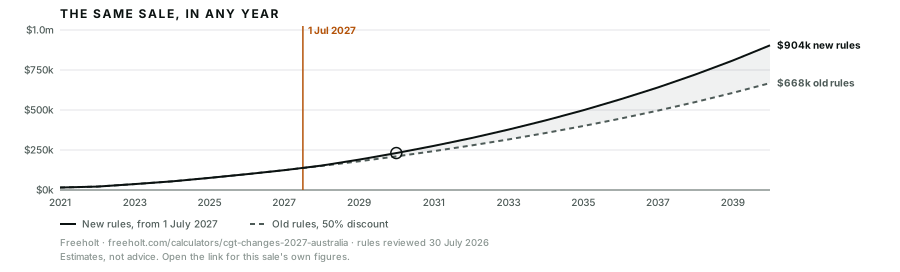
<a href="https://freeholt.com/calculators/cgt-changes-2027-australia"><img src="https://freeholt.com/api/calculators/cgt-2027/chart.svg" width="900" height="272" alt="Capital gains tax on the same sale in any year, under Australia's old and new rules, from Freeholt"></a>What if I sold before 30 June 2027?
A sale that settles on or before 30 June 2027 is taxed entirely under the old rules, so the two columns are the same; the chart above shows the same property sold in every year, and the gap that opens after the changeover is what the new rules cost or save for your numbers.
Holding past the date does not lose the discount on the gain already built up: that part is deferred to the real sale and keeps the 50% discount. What the date changes is the treatment of growth after it, which is indexed to inflation and bears at least 30%. For most sellers the difference is the size of the after part, and a valuation as at 30 June 2027 is what fixes it.
Who is excluded, and what is not counted
The test is tax residency, not citizenship: a foreign resident or a temporary resident at any time from 1 July 2027 to the sale is not eligible for indexation, and foreign residents have had no 50% discount for the period of foreign residency since 8 May 2012.
- Capital works deductions claimed. Depreciation on the building claimed while renting reduces the cost base, which raises the gain.
- Medicare levy surcharge. 1 to 1.5% more on top if you have no private hospital cover and income (with the gain) is above the threshold. Holding cover for the year of sale avoids it.
- HELP and other income-tested repayments. Study-loan repayments, Division 293 super tax and family-benefit tapers all read the year's income, which the gain lifts.
- Withholding at settlement. A foreign-resident seller has 15% of the price withheld by the buyer. It is a credit against this tax, not extra, but it is cash you do not see until you lodge.
- State land tax and duties. Annual land tax and the buyer's stamp duty are separate from capital gains tax.
- Temporary residents. Temporary-visa holders are excluded from indexation and the discount like foreign residents; the page asks only about tax residency.
- Small-business concessions, new-build exemption. Both can change the answer for the few they apply to and are not modelled here.
Questions people ask
What changes to capital gains tax on 1 July 2027?
From 1 July 2027 the 50% CGT discount is replaced by cost-base indexation plus a 30% minimum tax on the gain built up after that date. Gain built up before that date keeps the 50% discount. The change is in the Treasury Laws Amendment (Tax Reform No. 1) Act 2026, Schedule 1.
What if I bought before 1 July 2027 and sell after it?
The gain is split in two at 1 July 2027. The part built up before is deferred to your sale and still gets the 50% discount; the part built up after is indexed to inflation, gets no discount and bears at least 30% tax. The split is measured by the property's market value on the eve of 1 July 2027.
Do I need a valuation as at 30 June 2027?
A valuation fixes how much of your gain falls before the changeover, which is the part that keeps the discount. Without one the gain is apportioned by time held, which is rougher and usually less favourable when growth was faster before 2027. The choice is made when you lodge the return for the year of sale.
Is the 30% minimum a flat rate?
No. It is a floor on the after part of the gain: if the brackets that part lands in average less than 30%, a top-up makes up the difference, computed per owner under s 119-10(2). Someone already in the 37% or 45% band pays no top-up.
Are foreign residents or non-citizens eligible for indexation?
The test is tax residency, not citizenship. A permanent resident living in Australia is eligible. Anyone who is a foreign resident or a temporary resident at any time from 1 July 2027 to the sale is not, under s 114-25(2), and foreign residents have had no 50% discount for the period of foreign residency since 8 May 2012.
What if I sold before 30 June 2027?
A sale that settles on or before 30 June 2027 is taxed entirely under the old rules, with the 50% discount on the whole gain. Holding past the date does not lose the discount on the gain already built up, only the treatment of growth after it, so the calculator's chart shows the same sale in every year rather than a single answer.
Does the main residence exemption change?
No. Time the property was your main residence stays exempt, and up to six years of absence after moving out still counts under the absence rule. The exemption is applied to the gain first; only the remainder is split at 1 July 2027 and taxed.
How is the tax split between joint owners?
Each owner is taxed on their share of the taxable gain, added to their own income, so two owners on different incomes pay different amounts. Joint tenants split equally; tenants in common by their recorded shares. The calculator shows each owner's brackets and the 30% minimum test separately.
Does the change apply to an investment property I already own?
Yes, for any sale on or after 1 July 2027, but only to the gain built up after that date. The gain built up before it is deferred to the sale and still gets the 50% discount. A property sold before 1 July 2027 is taxed entirely under the old rules.
Which inflation figure is used for indexation?
The law uses the ABS consumer price index for the quarter of the sale over the index for the September 2027 quarter, rounded to three decimal places. Future CPI is unknown, so the calculator uses the annual rate you choose; the last 30 years of Australian CPI averaged about 2.7% a year.
Sources
Treasury Laws Amendment (Tax Reform No. 1) Act 2026 (No. 49, 2026), Schedule 1, as registered on the Federal Register of Legislation. Rules reviewed 30 July 2026. Inflation history: ABS consumer price index, annual change, 1996 to 2025. Federal Register of Legislation, C2026A00049.
Australia: what Freeholt models · Land tax calculator (Australia) · Compare property tax between countries